Rozewicz Previsited by Joanna Trzeciak Huss
The Fall 2026 special issue of The Polish Review (71.3), “Różewicz Revisited,” brings together new scholarship on Tadeusz Różewicz (1921–2014), one of the most influential figures in twentieth-century European literature, whose work transformed the course of both poetry and theater. Too often understood primarily as the poet of moral catastrophe, and sometimes mischaracterized as a nihilist, Różewicz was a restless experimenter who sought to expose the fragility of Western civilization and rebuild artistic expression from an ethical core.
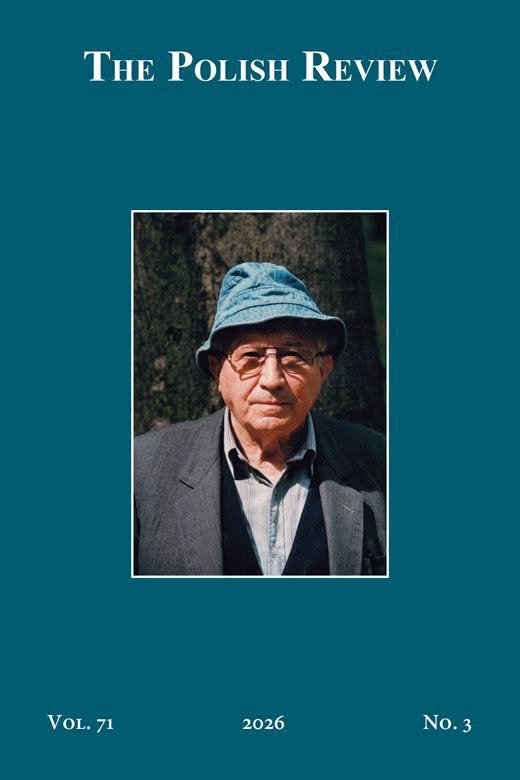
The special issue explores the breadth of his achievement through approaches ranging from philosophy and visual culture to Holocaust memory, textual revision, the politics of literary production under Stalinism, and contemporary gender theory. Rather than offering a definitive account of Różewicz’s work, the collection revisits his artistic and intellectual legacy from new perspectives, demonstrating its continuing capacity to ignite critical debate.
Several contributions focus on Różewicz’s poetry and its relationship to contemporary culture. Alina Świeściak traces the development of stupidity or folly as a central category in his critique of modernity, examining how his early efforts to represent the fragmented experience of postwar life evolved into a broader diagnosis of mass culture, information overload, and the moral and intellectual consequences of late capitalism. While acknowledging the force of this critique, she also questions Różewicz’s tendency to interpret systemic dysfunction as individual moral failure. Anna Kałuża examines the centrality of images to his poetic practice, arguing that his treatment of visual perception transforms language into a sensory and relational medium. Drawing on Lambert Wiesing, Kałuża explores the literary function of mental images divorced from any representational role. Marcin Czerwiński approaches Różewicz from the perspective of contemporary reception, experimenting with random readings of his poetry and proposing that its fragmentary, aphoristic quality lends itself to new forms of public engagement, including poetic murals and digital media. Together, these essays demonstrate how Różewicz’s formal innovations continue to invite new ways of reading.
Other contributions return to the historical circumstances in which Różewicz’s work emerged. Paweł Stępień offers a detailed study of seven surviving drafts of “Chaskiel,” a poem commemorating a Jewish child murdered during the Holocaust. His analysis reveals the painstaking process of reduction and revision through which Różewicz developed a poetic language capable of bearing witness without resorting to rhetorical excess. Piotr Krupiński and Mariusz Strzeżek introduce previously unpublished correspondence between Różewicz and the poet, translator, and essayist Witold Wirpsza, accompanied by translations of this correspondence and providing extensive historical commentary. The letters illuminate the political and cultural pressures confronting writers in Stalinist Poland, including censorship, self-censorship, and the negotiation of artistic autonomy. Turning to Różewicz’s dramatic work, Justyna Jaworska examines the changing reception and staging of his 1973 play White Marriage. Tracing nearly five decades of theatrical interpretations, she demonstrates how a work initially received as scandalous or grotesque has increasingly been understood through feminist, queer, and gender studies, particularly in relation to questions of embodiment, gender identity, and the instability of socially imposed roles.
The introductory essay situates these contributions within Różewicz’s lifelong commitment to artistic experimentation and what he called forms of “impure” expression. From the stripped-down language of his earliest collections to his later visual experiments with manuscripts, revisions, and the material processes of writing, Różewicz consistently challenged the boundaries separating literary genres from visual media, and the completed work from the creative process. What emerges in “Różewicz Revisited” is a portrait of an artist whose arresting work continues to resonate. The issue seeks not to establish a consensus about Różewicz’s achievement but to contribute to an ongoing scholarly conversation about a writer who remains a vital interlocutor.
Joanna Trzeciak Huss is a literary translator and professor at Kent State University, where she teaches Russian and Polish translation and translation studies. Her translations include Miracle Fair: Selected Poems of Wisława Szymborska, which won the Heldt Translation Prize, and Sobbing Superpower: Selected Poems of Tadeusz Różewicz, which won the Found in Translation Award and was shortlisted for the Griffin Poetry Prize. She wrote “Różewicz Revisited,” the introduction to the Fall 2026 special issue of The Polish Review devoted to the poet.