Seeing Lublin Through Different Eyes: Reflections on Professor Monika Adamczyk-Garbowska’s Plenary Lecture by Anna Muller
Academic conferences are places where we exchange ideas, discover new research, and reconnect with colleagues. Every so often, however, a lecture does something even more remarkable: it fundamentally changes the way we see a place we thought we already knew. That is exactly what happened to me—and, I believe, to many of us who had the opportunity to listen to Professor Monika Adamczyk-Garbowska’s plenary lecture, “A Holy City, a Cursed City: Lublin in Jewish Collective Memory,” during the PIASA World Congress.
Walking through Lublin’s Old Town, admiring its beautiful architecture, and meeting colleagues from around the world, it is easy to become absorbed in the city’s vibrant present. Professor Adamczyk-Garbowska reminded us, however, that beneath every street, every square, and every restored building lies another Lublin—a city remembered through literature, language, and loss.
Professor Adamczyk-Garbowska began with a personal story. She recalled arriving in the United States in 1981, at Lock Haven State College (now Lock Haven University) in Pennsylvania, during the Solidarity period. For a young scholar from communist Poland, the visit offered a rare opportunity to read books and journals that had been unavailable—or even banned—at home. Alongside Czesław Miłosz’s The Captive Mind, she immersed herself in the pages of The Polish Review, searching for articles on Polish-Jewish history. Those readings profoundly broadened her scholarly horizons and helped shape the direction of her future research.
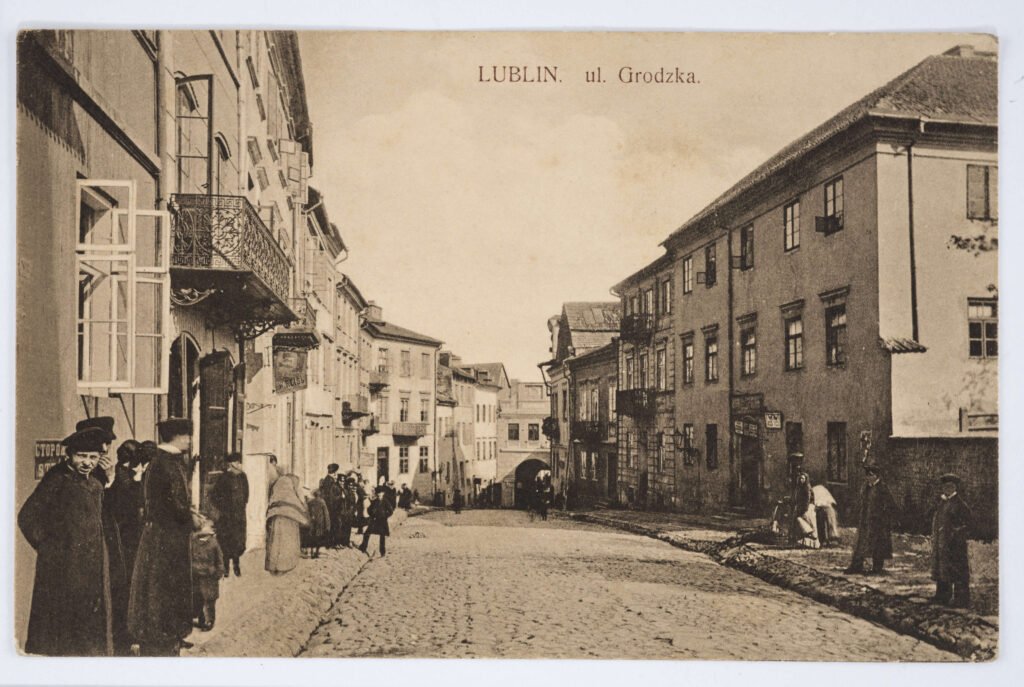
Postcard published by K. Wojutyński. Collection of the National Museum in Lublin.
Even more moving was her recollection of spending the 1988–1989 academic year in New York. Until then, Lublin had been, in her own words, simply the city where she had been born and educated—a somewhat provincial and neglected place. But in New York’s Jewish scholarly circles, everything changed. There, everyone knew Lublin. They pronounced it differently—Lubleen,” with the stress on the second syllable, as it is pronounced in Yiddish and Hebrew—and associated it with the Seer of Lublin, Yeshivat Chachmei Lublin, Isaac Bashevis Singer, Yankev Glatshteyn, centuries of Hebrew printing, and one of the most important centers of Jewish learning in Eastern Europe.
Her story reminded us—especially those of us who were born and raised in Poland—that sometimes we need to leave home in order to understand it. Looking at Lublin through the eyes of others allowed her to rediscover her own city and appreciate dimensions of its history that had remained invisible to her growing up.
Professor Adamczyk-Garbowska then invited us to imagine prewar Lublin—not as a city defined primarily by the Holocaust, but as a thriving multilingual community where one-third of the inhabitants were Jewish, where Yiddish filled the streets, and where Hebrew resonated in synagogues and houses of study. Rather than relying on demographic statistics or historical data alone, she brought this lost world vividly to life through literature, allowing us to experience Lublin as generations of Jewish writers had remembered it.
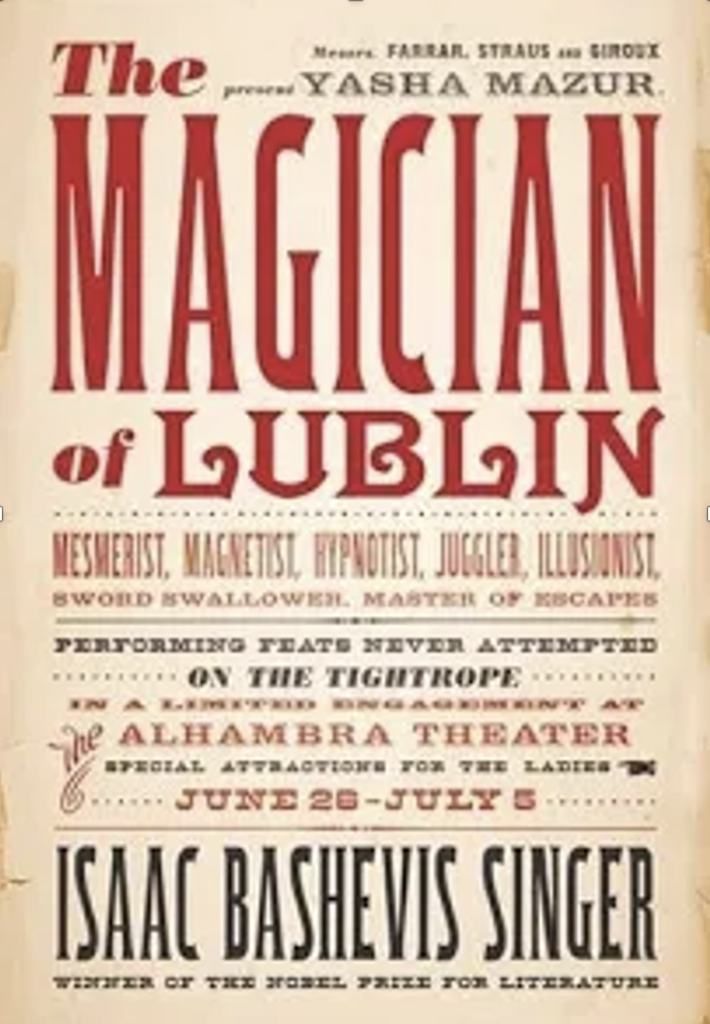
Isaac Bashevis Singer’s The Magician of Lublin depicts a city of stability, tradition, and spiritual continuity. Although the novel’s protagonist spends much of his life elsewhere, it is to Lublin that he ultimately returns in search of repentance and redemption. In Singer’s hands, what many modern Jewish writers criticized as provincial religiosity becomes one of the city’s greatest strengths. His Lublin was bustling, youthful, ironic, and alive—a city populated by craftsmen, merchants, workers, intellectuals, rabbis, children, and dreamers. The literary descriptions recreated an urban world whose complexity often disappears when we think about Jewish Poland only through the lens of destruction.
Of course, the lecture could not remain in that world.
One of its central arguments was that Jewish collective memory experienced a profound transformation during the Holocaust. Lublin ceased to signify centuries of scholarship and communal life and instead became synonymous with annihilation. Professor Adamczyk-Garbowska explored this transformation through the haunting phrase nusekh Lublin—once referring to Lublin’s distinguished tradition of Jewish learning, later becoming shorthand for the methods of deportation and mass murder implemented during Aktion Reinhardt.
The lecture reached an emotional peak through the poetry of Yankev Glatshteyn. His elegy Lublin, My Holy City mourns not simply buildings or neighborhoods but an entire civilization. Particularly striking was the image of removing one’s shoes before entering Majdanek because the ground itself had become holy through the suffering of countless victims.
Another unforgettable moment came when Professor Adamczyk-Garbowska discussed today’s Castle Square. Most visitors—including myself—see an open public square framed by attractive buildings. But through the work of literary scholar Władysław Panas, she revealed what is no longer visible: the densely populated Jewish quarter, the Maharshal Synagogue, and the vibrant neighborhood erased first by Nazi destruction and later by postwar urban planning. The reconstructed landscape, Panas argues, leaves behind “an empty spot”—a physical absence that becomes part of the city’s memory.
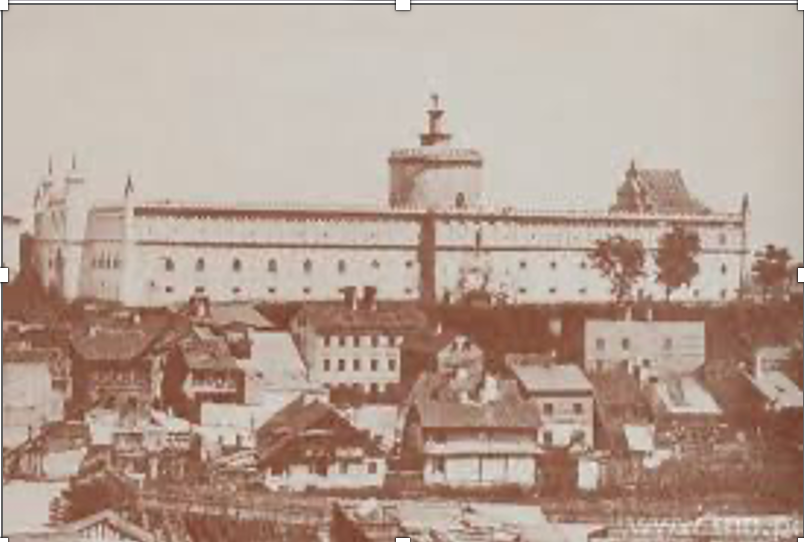
This is the 1917 postcard looking across the Jewish district toward Lublin Castle, published by Wydawnictwo Sztuka Kraków
The lecture also explored the voices of survivors returning to Lublin after the war. Nechama Tec’s memoir describes arriving in her hometown only to find a place whose sounds and smells no longer belonged to her. She recognized the city physically, yet emotionally it had become unrecognizable. Reading those passages aloud, Professor Adamczyk-Garbowska reminded us that places survive wars very differently from people. Buildings may be rebuilt; communities often cannot.
When I next return to Lublin, I know I will walk its streets more slowly. I will hear echoes of Yiddish alongside Polish. I will imagine the vanished synagogues hidden beneath today’s open squares. I will remember that every restored façade stands alongside stories that cannot be reconstructed so easily.
What I appreciated most was Professor Adamczyk-Garbowska’s refusal to reduce Lublin to a single narrative. It was neither only a “holy city” nor only a “cursed city.” It was a place of scholarship and everyday life, of literature and faith, of destruction and remembrance. Holding all of those histories together is not easy, yet her lecture managed to do so with remarkable clarity. It was a fitting plenary for a congress devoted to understanding Poland in all of its historical complexity.
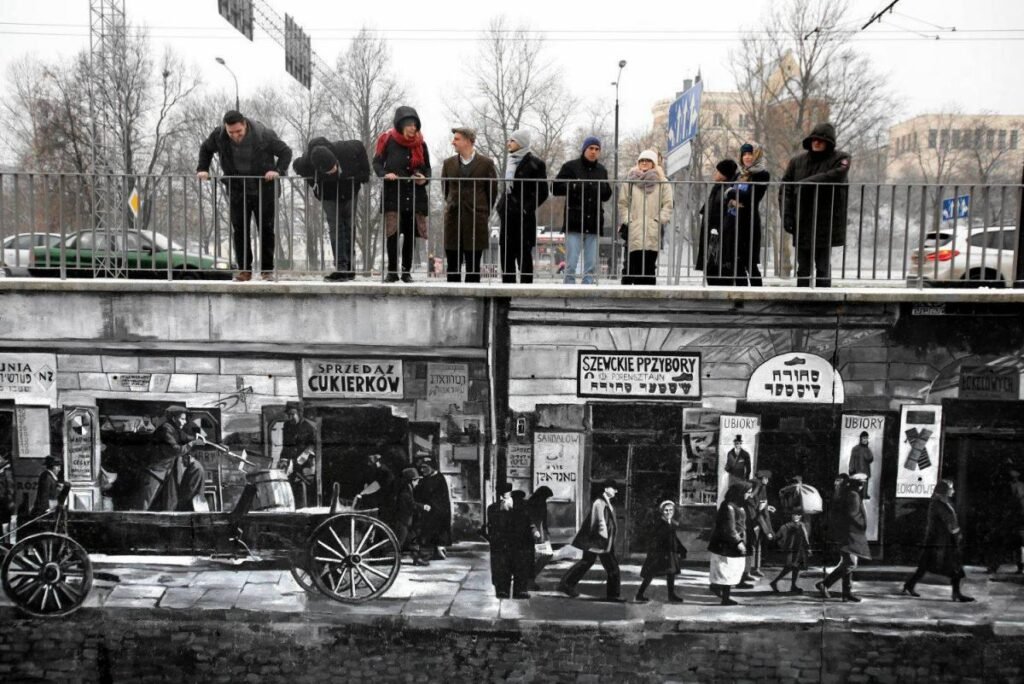
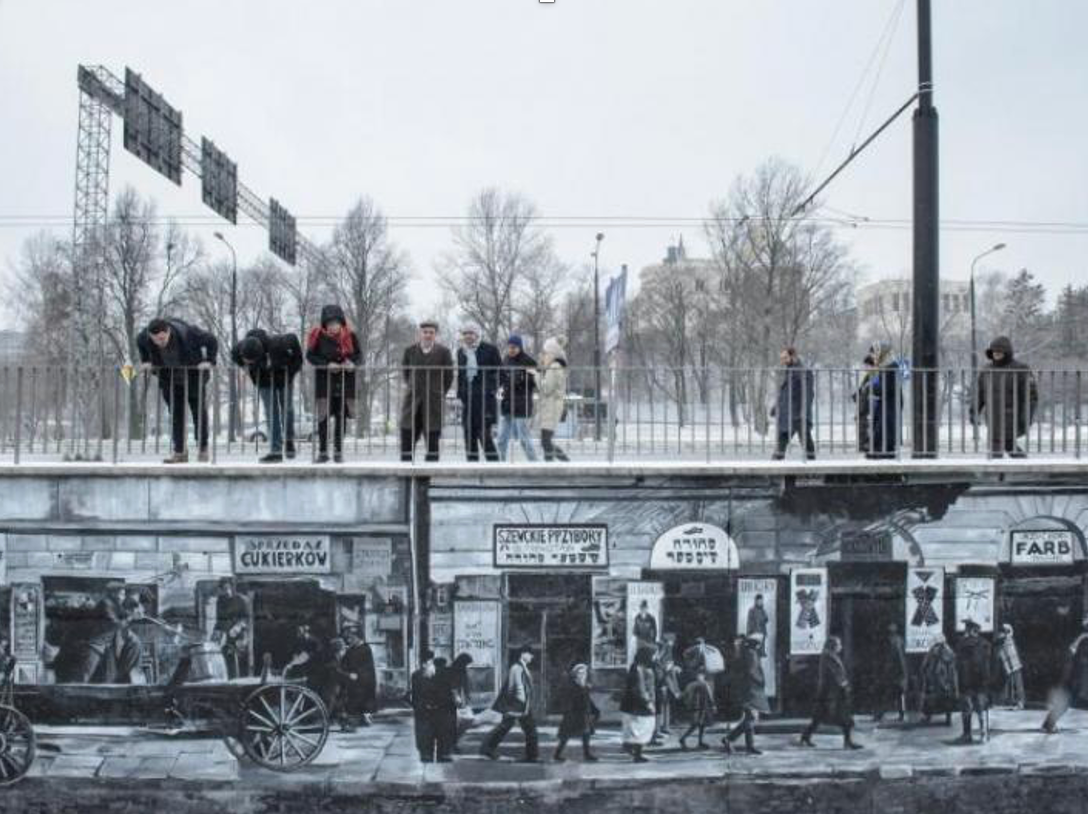
Photograph by Jakub Orzechowski, December 2016. Originally published in Gazeta Wyborcza Lublin in connection with the unveiling of the mural.