Czytamy – the Polish-American Women’s Book Club – Takes Flight by Wanda Urbanska
Mired in covid in Raleigh, North Carolina back in 2020—with everything from doctor’s visits to birthday parties going online—I hatched the idea of creating a virtual book club for English-speaking Polonophiles.
My work promoting the legacy of Jan Karski in the U.S. —first by leading the successful, 2012 Presidential Medal of Freedom campaign and later by co-creating the Jan Karski Educational Foundation—had introduced me to a broad circle of mostly female friends who care deeply about their country of birth or heritage. We bonded over a fascination with Polish history and literature and dismay over its lack of representation in American classrooms, bookstores, and in the national conversation. Would these friends commit to reading books about Poland and the Polish-American experience and meeting regularly to discuss them?
To beta-test the idea, I turned to my sister Jane, a partner in the Karski work, and a new friend, Mariola, president of the Polish American Club of the Triangle. Their enthusiastic response led to a steering committee. Most decisions were easy. We would keep the club to ten members; meet every two months; and alternate discussion leaders. Deciding whether to include men was harder. While I longed to invite Leonard Kniffel, the editor-in-chief of American Libraries magazine, thinking long-term, we opted for a women-only club so female voices would be heard.
I sent emails and made calls to recruit members in five states; they were all Polonia-engaged and included published authors, dedicated readers and a Polish Studies department chair. Most everyone enthusiastically signed on. (Only one arm had to be twisted, and that member went on to become the second club president!) The name—Czytamy (Polish for “we read”) Club—was decided by vote.
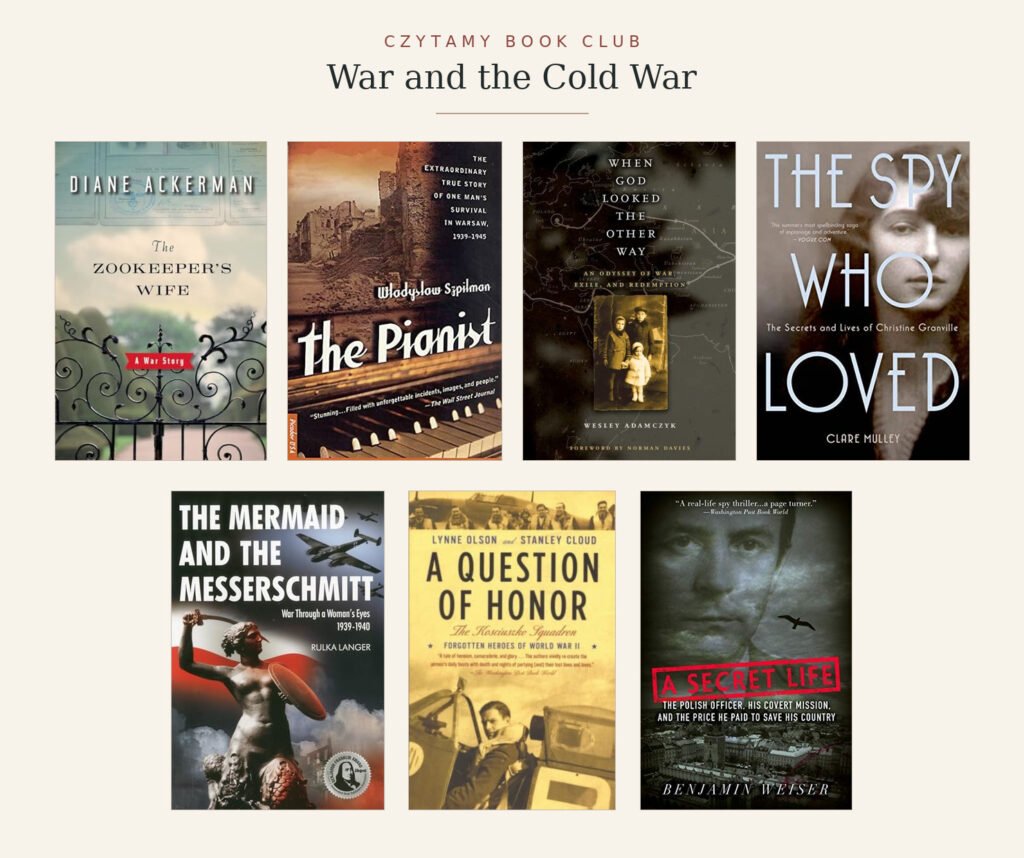
The first meeting was held via zoom on March 7, 2021, to discuss The Zookeeper’s Wife by Diane Ackerman, the popular, 2007 work of creative non-fiction about a Warsaw couple, passionate risk-takers who put their lives on the line to save Jews during World War II. That initial discussion set the tone for the thirty-odd meetings to follow. Overall, reactions to that first book were positive–members were pleased that this little-known story about Polish wartime heroism had been popularized and made into a film–but that didn’t stop eagle-eye readers from pointing out historical and cultural missteps made by the author.
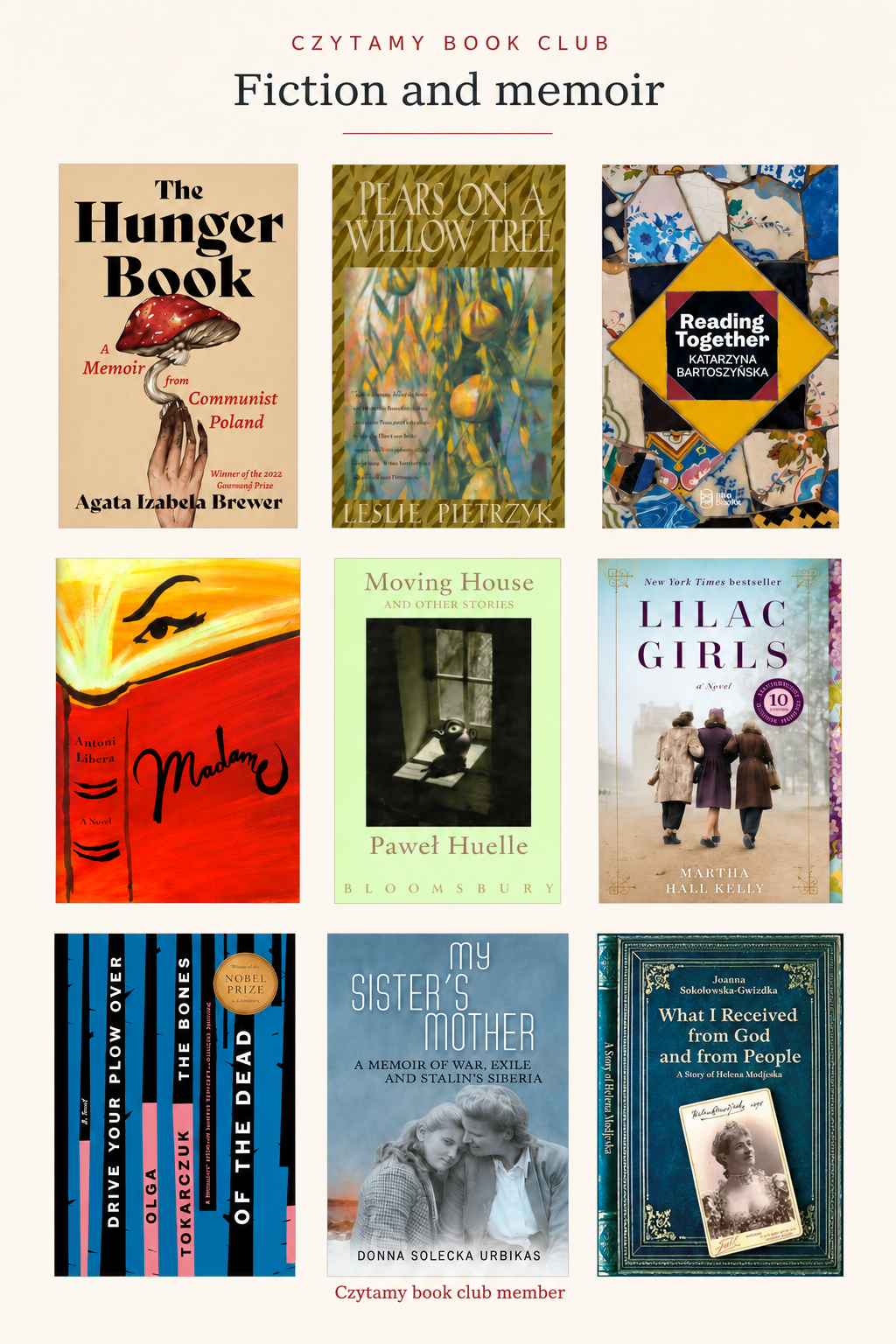
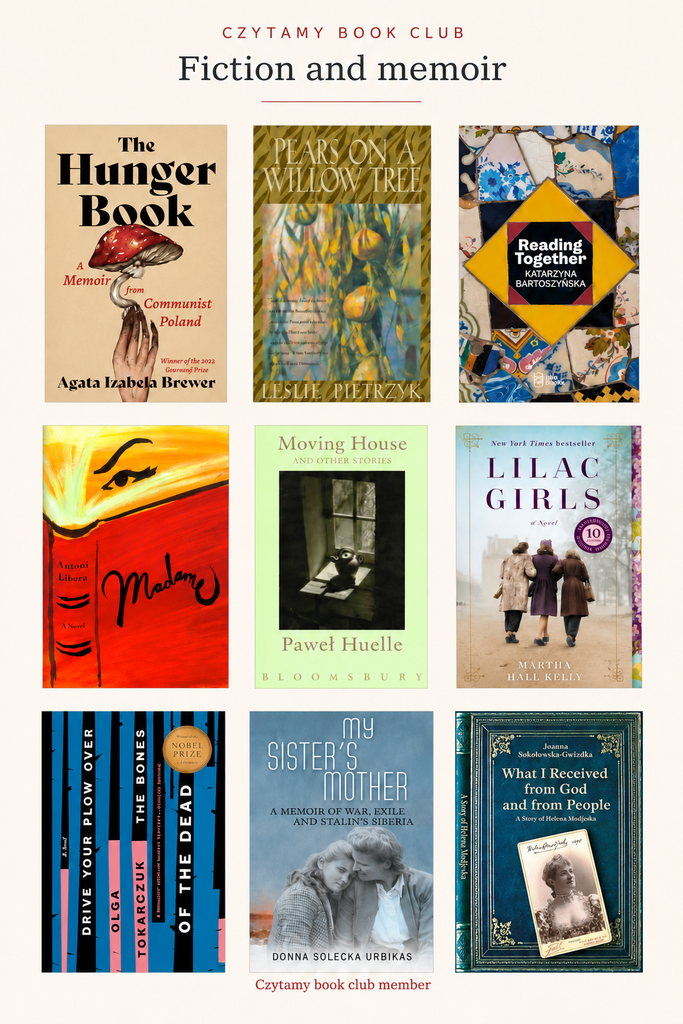
Our early titles—The Pianist by Władysław Szpilman; When God Looked the Other Way by Wesley Adamczyk; The Spy Who Loved by Clare Mulley; The Mermaid and the Messerschmitt by Rulka Langer; A Question of Honor by Lynne Olson and Stanley Cloud—leaned heavily on the Second World War, a seminal experience in the life the nation, and source of endless fascination for me personally. Soon, however, members expressed “World War II overload,” wanting fresher, less-depressing (and less-predictable) themes. We pivoted to narratives about celebrated women, such as the silent film star Pola Negri and the 19th century stage actress Helena Modjeska, often called “the Polish Sarah Bernhardt.” We read about how the struggles of alcoholism played out in multi-generational Polish families in The Hunger Book by Agata Izabela Brewer and Pears on a Willow Tree by Leslie Pietrzyk. We tackled several obscure books on the Polish-American immigrant experience before deciding, once again, to move on. At 100 pages, our shortest book and perhaps most apropos selection, Reading Together by English professor Katarzyna Bartoszynska, made the case for discovering new texts in a book club setting rather than in academia where professors pontificate and pull rank.
No one could accuse our members of taking the club lightly. Filled with tough critics and discerning readers—and, yes, occasionally sharp elbows—almost everyone reads every book cover to cover. Thought-provoking discussion questions are distributed by the book leader in advance of the meeting but, in truth, we rarely get to them all. Like a class of overachievers, members often go the extra mile, researching the authors, reading background articles and citing previous books to offer up relevant insights and occasionally first-hand gossip.
Arguably the group’s most popular book to date has been Madame by Antoni Libera, an exquisite coming-of-age story about a Polish youth who falls in love with his French teacher. Pawel Huelle’s Moving House and Other Stories—focusing on the themes of ethnic identity and confusion in Gdańsk in the aftermath of World War II as Poles displaced the German majority there—came in a close second. Discovering hidden treasure together has proved both satisfying and unifying. That said, not every book selection has reached that high bar.
One of our most heated sessions came early on, in the second meeting, on May 16, 2021. Members clashed over Benjamin Weiser’s A Secret Life, about the Polish Army Colonel Ryszard Kuklinski who spied for America during the Cold War in the 1970s. The US-raised members—who represent half of the group—all applauded Kukliński as an extraordinary hero, while the Polish-born participants cast him as a traitor, a man who betrayed his colleagues. That the Polish military was under the thumbs of the Soviets who had a nuclear target on Poland’s back, in their minds, did not excuse the man’s subterfuge, nor the lifestyle of comparative luxury he enjoyed due to his work for the Communists.
Another lesson learned is that even flawed books are worth reading. Lilac Girls by Martha Hall Kelly, a New York Timesbest-selling novel focusing on three females—a Polish teenager, a German doctor and an American socialite—is a prime example. The lives of the three women intersected during (and after) World War II as the Pole was interned at the Ravensbrück concentration camp in Germany, ground zero for hideous medical experiments. While readable and well-intentioned, Lilac Girls was riddled with factual errors.
One of our members sent a diplomatic email to the author, outlining these lapses in detail, while sharing heart-felt background about her own family history. She read her email aloud to the group assembled at our group’s first in-person gathering. In it, she offered to correct—free of charge—the errors in a subsequent edition. “I care deeply about an accurate image of my home country,” she told me later. “Since moving to the U.S., I have encountered so many misconceptions and inaccuracies about Polish history, culture, and people that, when I read the book, I felt it was my chance to correct them.”
Kelly’s answer was terse and dismissive: For her next “Polish” book, she would be sure to reach out. That was it. Her note failed to respond to the generous offer, much less apologize for—or even acknowledge—her mistakes. The brush off from the author took our collective breath away. Our member had spoken for us all, and our unanimous support celebrated her initiative. That moment reinforced our collective understanding that there was more work to do.
As the club has evolved, the membership has grown to twelve, representing seven states. We’ve added a “check-in moment” to share family news, professional highlights, and health and travel updates. We have met the challenge of arranging meetings over multiple time zones (including Central European Time) by varying discussion times.
November 2023 brought the first in-person gathering in Raleigh, which served to coalesce our group. There, we made a pilgrimage to the 1952 architectural masterpiece, the J.S. Dorton Arena, designed by Polish architect and NC State department chair, Maciej Nowicki and attended the annual Paderewski Festival concert at St. Mary’s School. Gatherings in Chicago and New York City followed, with members planning itineraries to highlight Polish-themed attractions (such as touring the Polish Museum of America in Chicago and finding family records at the Ellis Island archives). Local members have outdone each other by hosting lavish meals and accommodating out of towners in their homes. Detroit is next up.
We have done deep dives into mushroom hunting, pierogi making and the coming of age of both Ignacy Jan Paderewski and Dan Rostenkowski. We learned about fearless world-class mountain climbers and the women who hijacked a plane in 1982 to escape martial-law Poland. With each book we read, many more beckon. While Nobel laureate Olga Tokarczuk’s Drive Your Plow Over the Bones of the Dead made our list, we have not yet touched the works of fellow laureates Wisława Szymborska or Czesław Miłosz. Not to mention, Norman Davies, Anne Applebaum, Adam Zamoyski, Joseph Conrad, Henryk Sienkiewicz, Bolesław Prus, and Stanisław Lem.
One thing we all agree on: We will never run out of books to read.
At the outset, I had no idea whether the club would take off. Five and a half years in, the club is flying high. Full of life, fuel and, occasionally, turbulence. Proof of our success? The long waiting list of those who want to climb on board.
Wanda Urbanska is a writer, journalist, and public television producer based in Rappahannock County, VA. A graduate of Harvard University, she is the author or co-author of nine books, including The Heart of Simple Living, and has written for The Washington Post, the Chicago Tribune, and American Libraries. She created, produced, and hosted Simple Living with Wanda Urbanska, a series on sustainable living that aired on public television stations nationwide from 2004 to 2009.
Urbanska led the campaign that helped secure a posthumous Presidential Medal of Freedom for Jan Karski in 2012. She went on to serve as the founding president of the Jan Karski Educational Foundation from 2012 to 2015 and now serves on its advisory board. Her work promoting Polish history and culture in the United States has earned her the Knight’s Cross of the Order of Merit of the Republic of Poland and the Polish American Historical Association’s Skalny Civic Achievement Award. In 2021, she launched Czytamy, a virtual book club for women interested in Polish literature, history, and the Polish-American experience.
The Czytamy Club is replicable: either an in-person or online. Feel free to contact Wandaurbanska@gmail.com for more information on how to start a chapter.